
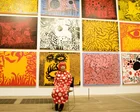
The pioneering Japanese artist talked openly about how her mental health and neurodivergence informed her creativity, paving the way for the likes of Turner prize winner Nnena Kalu
Yayoi Kusama – who has died at the age of 97 – was 10 when she first started experiencing vivid hallucinations consisting of visual and aural disturbances, which she described as “flashes of light, auras, or dense fields of dots”. A drawing from 1939, of a woman in a kimono assumed to be her mother, shows her obliterated by those dots; they would become Kusama’s artistic obsession.
She hallucinated flowers, too. “I was looking at the red flower patterns of the tablecloth on a table, and when I looked up I saw the same pattern covering the ceiling, the windows and the walls, and finally all over the room, my body and the universe”, she once said, when asked about that recurring motif.
“I felt as if I had begun to self-obliterate, to revolve in the infinity of endless time and the absoluteness of space, and be reduced to nothingness.”
For Kusama, art making was a means of survival. “I fight pain, anxiety, and fear every day, and the only method I have found that relieved my illness is to keep creating art.
I followed the thread of art and somehow discovered a path that would allow me to live”, she said in a 2012 interview . In so doing, she became one of the most acclaimed and admired contemporary artists, staging happenings and influencing the pop art movement as a pioneering figure in the New York avant garde.
Her exhibitions and major retrospectives draw huge crowds. In 2022, due to enormous public demand, Tate Modern in London extended her Infinity Mirror Rooms show for a whole extra year (it ended up running until 2024).